   Marisol began as an art project where the visual artists came up with the theme and the looks of the game over the course of 8 weeks.
   The designers and programmers joined the project after and added gameplay that enhanced the experience
   Marisol is a beginner-friendly, first-adventure kind of game that combines combat with puzzles, but first of all, it is a visually pleasing experience that tells a story through world building.
Published Platform
Itch.io
Team size
23
Engine
Unreal Engine 5
Project Length
8 weeks
Individual Role
Level Designer
Role and Contribution
Level Designer
- Researched target games and gathered reference materials to guide layout direction.
- Sketched level concepts, room ideas, and overall flow before moving into blockout.
- Built blockouts to test space sizes, pacing, and guidance for the player.
- Designed room encounters and puzzles with the story and player experience in mind.
- Worked with the programmers to set up puzzle logic using the puzzle tool.
- Playtested regularly and adjusted layouts and encounters based on feedback.
- Communicated with the team to keep production moving smoothly and avoid bottlenecks.
Level Design
Research
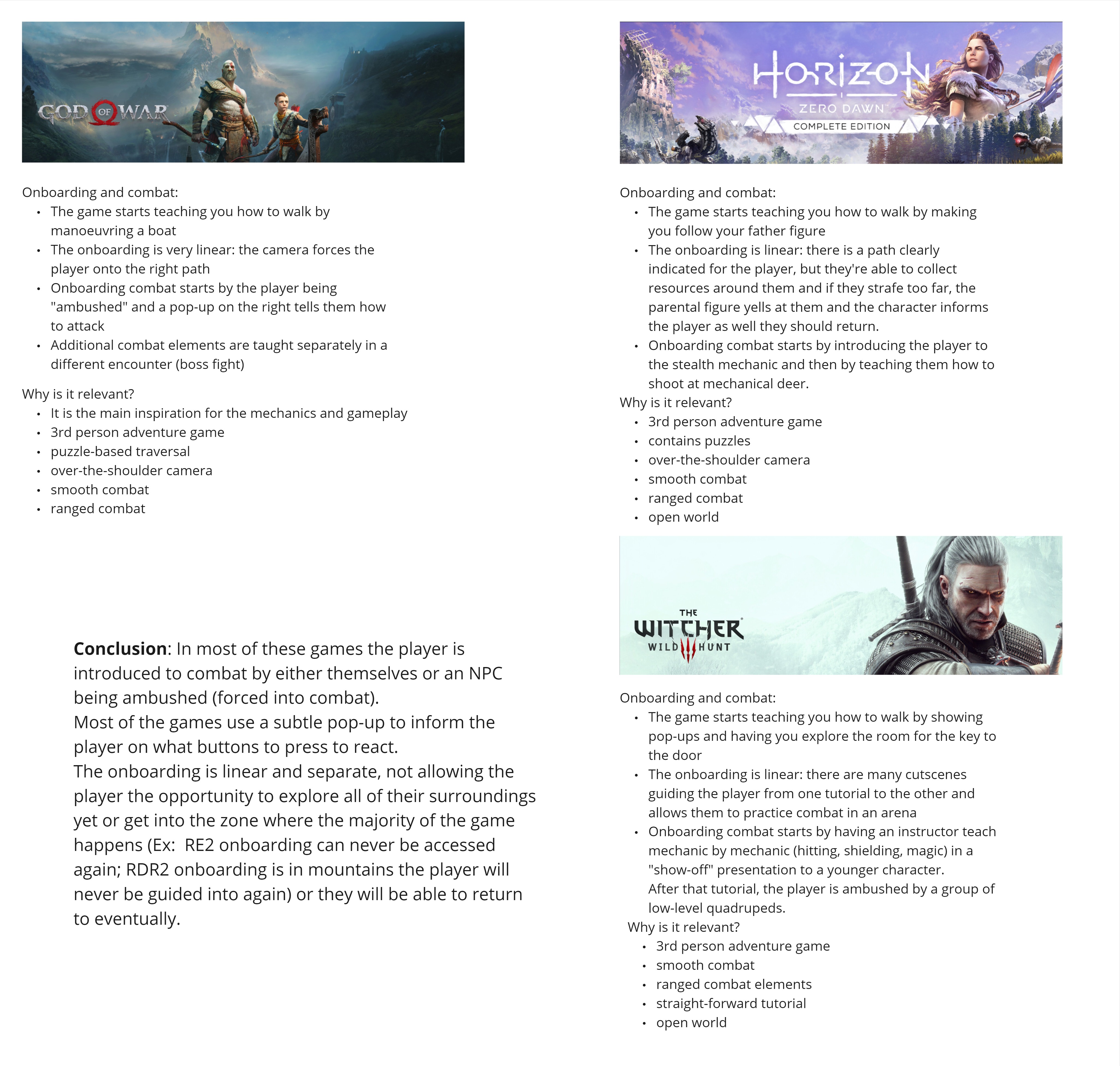
With the genre established (action-adventure), I researched progression systems and level layouts from popular titles in the space, focusing particularly on their onboarding sequences and first levels.
- I chose these games carefully, making sure each one was relevant to what we were trying to achieve and who we were designing for.
- I took notes on how each game introduced difficulty, paced their tutorials, and eased players into puzzles.
- I took what I learned and applied it to our own room and level concepts, aiming to create something that felt natural and welcoming.
Conclusion to the research
    In most of the games researched, the onboarding is a tight experience. The player is not allowed to leave the premises either by warning (Horizon Zero Dawn) or by being physically constricted by the map (God of War). Additionally, the researched games, most of them, come with an NPC to instruct the player of the controls and the world around them through dialogue.
    When it comes to combat, most of the researched games opted to throw the player in the middle of the action and then to further layer the experience into a teaching one.
Sketching
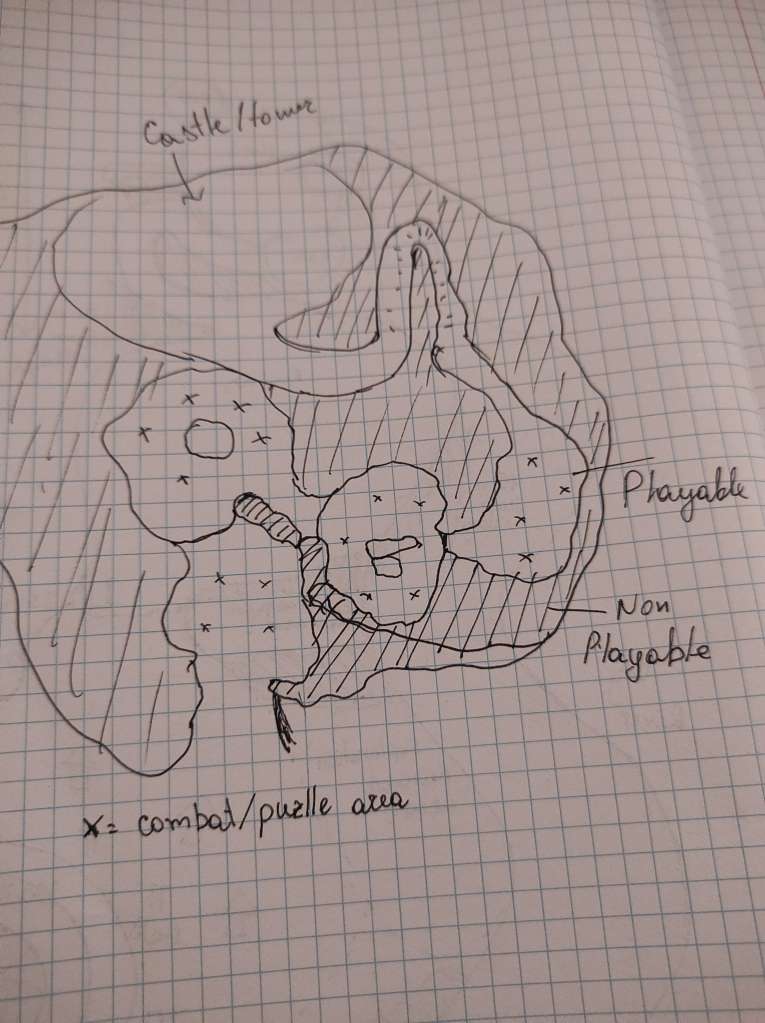
Gameplay comes in the form of four rooms that follow the KISHOTENKETSU setup.
KI - Introduction
SHO - Development
TEN - Twist
KETSU - Conclusion
With this set-up I ensure that gameplay scales smoothly in difficulty, is interesting and challenging.
Room 1:   x1 Ranged Crab Enemy
                x1 Stairs Puzzle

Room 2:  x2 Ranged Crab Enemy
                x1 Bridge Puzzle

Room 3:  x1 Lance Crab Enemy
                x1 Door Puzzle

Room 4:  x2 Ranged Crab Enemy
                x1 Lance Crab Enemy
                x1 Pattern-Recognition Puzzle
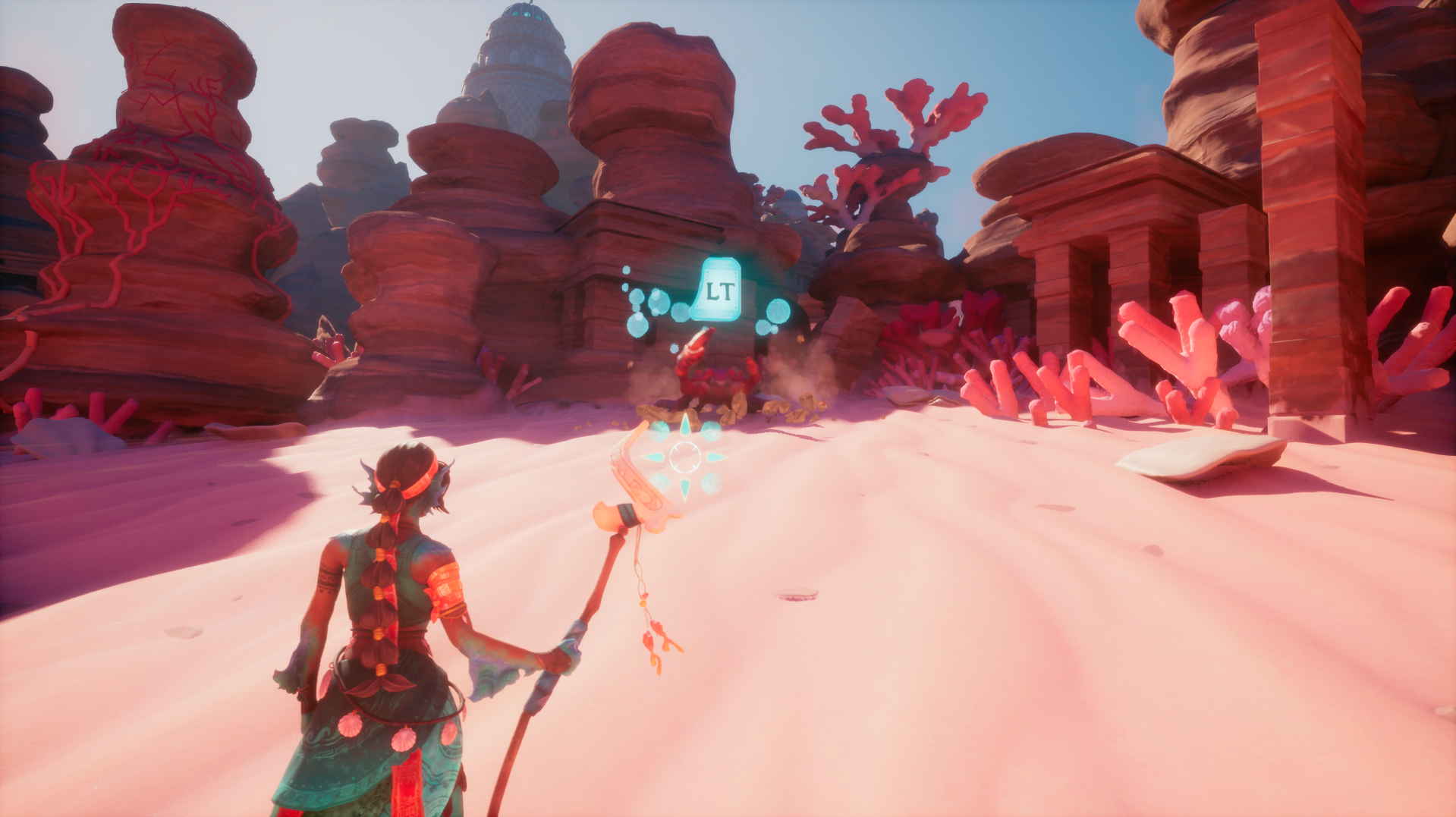
Additionally, after playtesting we determined that an onboarding area was needed before the action-focused beats.
This was done by splitting the 'Ranged Crab' enemy's two abilities: 'Throw' and 'Ground Slam' in two separate enemies who could do only one or the other, and slowly teaching the player about their combat abilities including attacking and shielding.
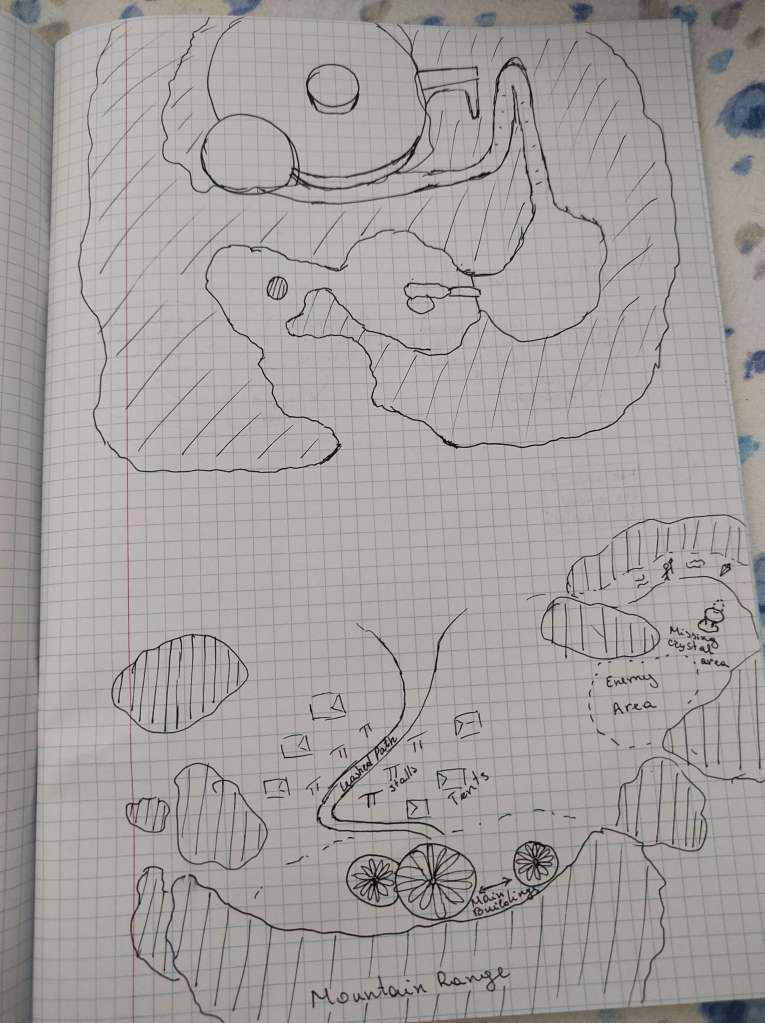
Areas of interest and vistas were planned at the initial stage of sketching too.
From the very beginning, I planned for 'The Village' and 'The Witch Tower' to be two areas of interest for the player.
'The Village' ended up being our most visually appealing piece that we dressed for narrative. Here the player is introduced to their goal via dialogue with an NPC and they get to find out about the story via worldbuilding and character design.
'The Witch Tower' became the landmark that the players could seek and be leashed towards the finale of the game. This was planned and kept in mind when sketching and is the largest influence over the verticality and the flow of the ruins.
I planned the ruins to always have 'The Witch Tower' within sight and if the players did lose it visually, they would either soon find it or be aware of its location in the world.
Cut content: Onboarding Quest
When concepting the course of the game and following the takeaways from the research, I planned for the player to discover about their abilities, world and the lore of The Village via a fetch and protect quest.
The quest was to recuperate the apprentice of the blacksmith who had materials required to get the staff - the player's weapon fixed.
Through dialogue and encounters, the player would find out more about how The Village has been surviving and how they've fallen under the extortion of the Sand Witch - the villain who took residence in The Castle beyond The Ruins.
Upon return, the player would get the full abilities of their weapon, be able to proceed into The Ruins and find out about a weapon upgrade system via the blacksmith.
Blockouts
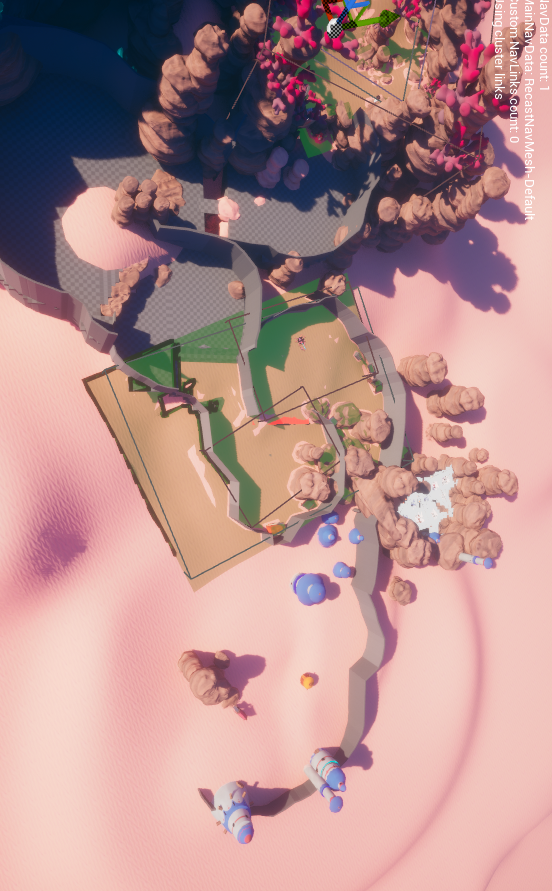
Blockouts were made utilizing Unreal Engine's 'Modelling Mode'.
I blocked out each area: The Village, Onboarding, Room 1, Room 2, Room 3, Room 4 and The Pathway, leaving The Witch Tower for the environment artists as it involved little gameplay.
When blocking out the world, I tested for duration and combat room size.
We planned for around 30 minutes of gameplay for our student game and I planned the areas accordingly
   The Village ~ > 1 minute
   Onboarding ~ 3-4 minutes
   Room 1  ~ 4 mintues
   Room 2 ~ 6 minutes
   Room 3 ~ 4 minutes
   Room 4 ~ 7 minutes
   The Pathway ~ > 1 minute
   The Witch Tower ~ 3 minutes (including final dialogue)
For this project I also familiarized myself with Unreal Engine's Landscaping tool and utilized it for setting up verticality.
The implementation of the blockout was a great step for our game's production as after I was done with it, it allowed the environment artists to begin set-dressing the world and turn the level into the one that is today.
Encounter Design
I planned out the encounters and what they would be about in Miro alongside narrative descriptions.
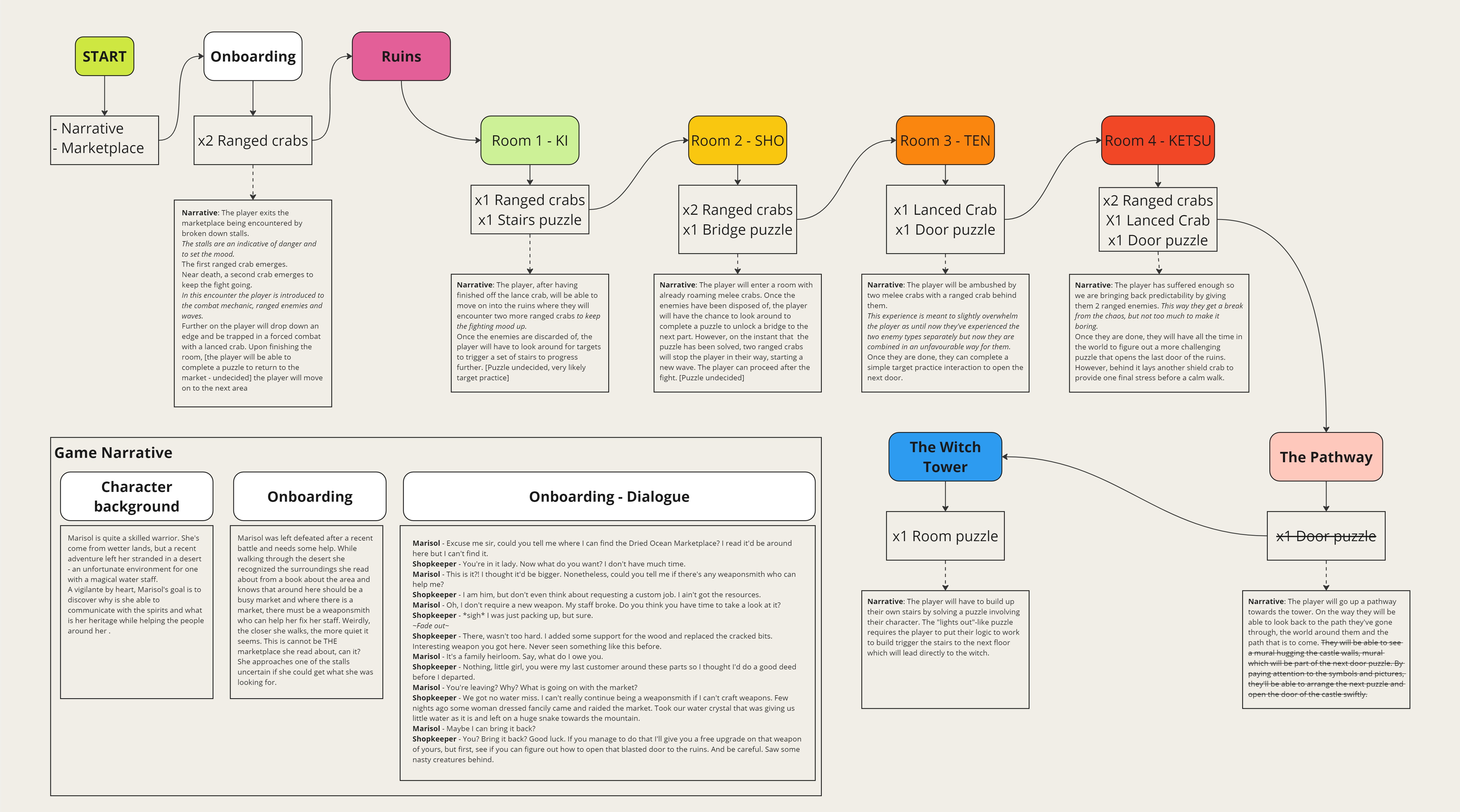
For encounter and beat design I followed the premises of KISHOTENKETSU, making the scaling of difficulty an exponential experience. The planning accounted for puzzles alongside combat.
I assumed and calculated difficulty based on the design of the enemies and how long they take to be defeated. Here collaboration with the AI Designer was key and we worked together to create playspaces that would allow her enemies to flourish and for my rooms to tell their story, and puzzles to challenge and entertain the players.
Combat
Before I could begin designing the rooms, I had to know what our enemies did.
Our most used, and easiest to deal with - the Ranged Crab enemy, has two attacks: Throw and Ground Slam, both done from far away. The crabs also went into hiding if the player would get too close, so I already knew I had to make spacious rooms for both the crabs to move around and the player to be able to dodge.
I onboarded the player to its abilities slowly and in a controlled space, blocking them from progressing until they had a successful parry as the parrying ability would become a lot more important later.
After onboarding the level babysits the player a lot less and I let them deal with the crabs alone.
Encounter Breakdown
Room 1 - KI had one crab to be dealt with that had both of the introduced abilities.
The room prepared for this enemy was a medium one dressed with a column in the middle and the player had the liberty to kite back as the enemy approached up until the point that the enemy would reset, but this would reset its health too.
Room 2 - SHO reintroduced the ranged crab, but now in an outnumbered stance. The player had to defeat two of them before they could continue with the next progression challenge.
The room for this encounter was a corridor-like and the crabs were stationed to block the way forward.
Room 3 - TEN. As the stage implies, comes with a twist: new enemies. In this room the Lance Crab enemy gets introduced. This one likes to get close to the player, has a similar shield as the player to block their attacks. The twist is that when the crab attacked, the player could shield and parry them, giving them plenty time to attack.
The room for this encounter favored the enemy as I locked the player in a small arena and forced them to adapt to the lack of space, and utilize the mechanics they were previously taught.
Room 4 - KETSU. The combat in this room as the conclusion mixed all the enemies in a combination of two ranged enemies and then a melee enemy that came in as the final challenge after they solved the room's puzzle.
The room assembled for this encounter was a large one, favoring the ranged enemies, and when the melee enemy would come, the player would have a bit more space than previously to deal with the enemy that had just given them a struggle.
Puzzles
We were aware that the player could technically send the crabs in hiding mode.
That is exactly where the puzzles intervened as all the puzzles I designed involved progression limitation in true God of War style.
All the puzzles I designed had to meet a few criteria: be beginner friendly as per our difficulty intent, block progression and utilize 3Cs mechanics.
Additionally, in order to fit our worldbuilding and create a smooth blend between our features, I designed and implemented our puzzles to be old-temple-like and simple. This can be see in their design and solutions.
Puzzle Breakdown
Onboarding - Here I took the opportunity to teach the player how to utilize their weapon to interact with the world around them. The Door puzzle is a 'target practice' and the player can take their time with it as it teaches them how to aim and shoot.
Room 1 - The puzzle here is a similar 'target practice', however it is timed. The player can find ancient levers that upon shooting them, they will trigger. The player will be also able to notice the lever slowly resetting and upon shooting both of them in time, a set of stairs will descend and allow the player to continue their journey.
Room 2 - Bridge puzzle. The player faces a bridge and a stone plate. Upon stepping on it, on the other side they can see a collapsing pillar that they can shoot to fall on the other side of the bridge and keep it open.
Room 3 - Door puzzle. As here we are introducing a new enemy, I thought to not challenge the player too much with puzzles and re-utilized the door puzzle from Onboarding, but with the twist from Room 1, by using the same levels.
Room 4 - As a culmination to all the Ruins puzzles and to reinforce our desire to have the player look at the environment, as all the previous puzzle did, I assembled a pattern-recognition puzzle. At the end of the room there is a door with symbols and arrows on it. One of the symbols is buried under sand, making the player think and consider which symbol it may be.
The player can find all the symbols in that same room and shoot them in the right order to get the door to descend and allow pass further.
Extra Implementation
Besides implementing the blueprints for the puzzles and interactables, I got the opportunity to implement the UI for our onboarding.
For this I worked closely with our concept and 2d artists to update and implement and update the spatial UI.
Additionally, I worked with the VFX artist to implement and adjust onboarding UI and other effects in the game. This experience allowed me to learn how to work with Unreal Engine's Niagara System and how to set up VFX to be adjustable by developers.
QA and testing
The level has gone through multiple iterations and the data that backed up the changes came from playtesting.
The data gathering was done efficiently and consciously of our target audience. We aimed to test with unfamiliar teammates, classmates, but the best data came from other studies within our university.
When one was testing, they were gathering information for the other roles too. Afterwards, each designer would store information in a word document and we would adjust our game accordingly.
Some important changes that came from playtesting were
- Adding visual cues (the sparkles) to the lever puzzle to bring attention to it as a targetable
- Adding visual cues (dust) to the moving staircase
- Creating the onboarding section that allowed the players to slowly learn about our mechanics and enemies.
- Create gates that block the player in and out of combat to make sure that they do not skip over them.
- Difficulty balancing of Room 1 and 2 which initially had 2 and 3 respective enemies.
Conclusion

For an eight-week project, Marisol was a fun one.
The greatest challenge came from balancing work and limiting ourselves to our powers. As a design team composed of three, me being the only Quest-Level and Narrative designer, I felt overwhelmed at times.
I had to make hard decisions about the game, give up on ideas that were fun and make space for refining and improving the core identity of the game.
I'm proud to say that I succeeded that and although there are many "What could it had been"-s as with every project, Marisol got as close as it could to what we imagined it to become.

